20 Common Dart Mistakes Beginners Make – and How to Fix Them
You throw one dart into the 20, the next into the 5 and the third somewhere between the two. Then you change your stance, grip, shafts and darts in the same evening. This guide shows you the common dart mistakes beginners make and what to change first.
If you are searching for how to get better at darts, the answer is rarely “buy everything again”. Start by keeping a stance, grip and setup long enough to see what is actually happening.
You do not need a textbook-perfect throw. You need a throw you recognise. Stand in the same place, hold the dart without strangling it and finish the movement. Then do it again.
One bad visit tells you very little. The same miss appearing night after night tells you much more.
The useful rule: change one thing at a time. If you alter the stance, grip and darts together, you learn nothing from the result.
Beginner darts, dartboard lighting and surrounds
You do not need all three. New darts make sense when the weight, barrel shape or grip of your current set does not suit your hand. A light helps when shadows cover the board. A surround protects the wall when darts still miss outside the doubles.
The Amazon button opens the Red Dragon Amberjack range. Check that you have selected steel tip, the right Amberjack model and the weight you want.
The Amazon button opens the Winmau Plasma light. Darts Corner opens its full lighting range, so you can compare rings, partial lights and different fittings.
A surround protects the wall around a standard bristle board. It does not correct your throw and it will not catch a dart that misses by half a metre.
Links checked on 28 July 2026: Amazon can group models and weights on one page. Read the selector before ordering. The Darts Corner buttons open current UK collections rather than pretending one product suits every beginner.
Contents
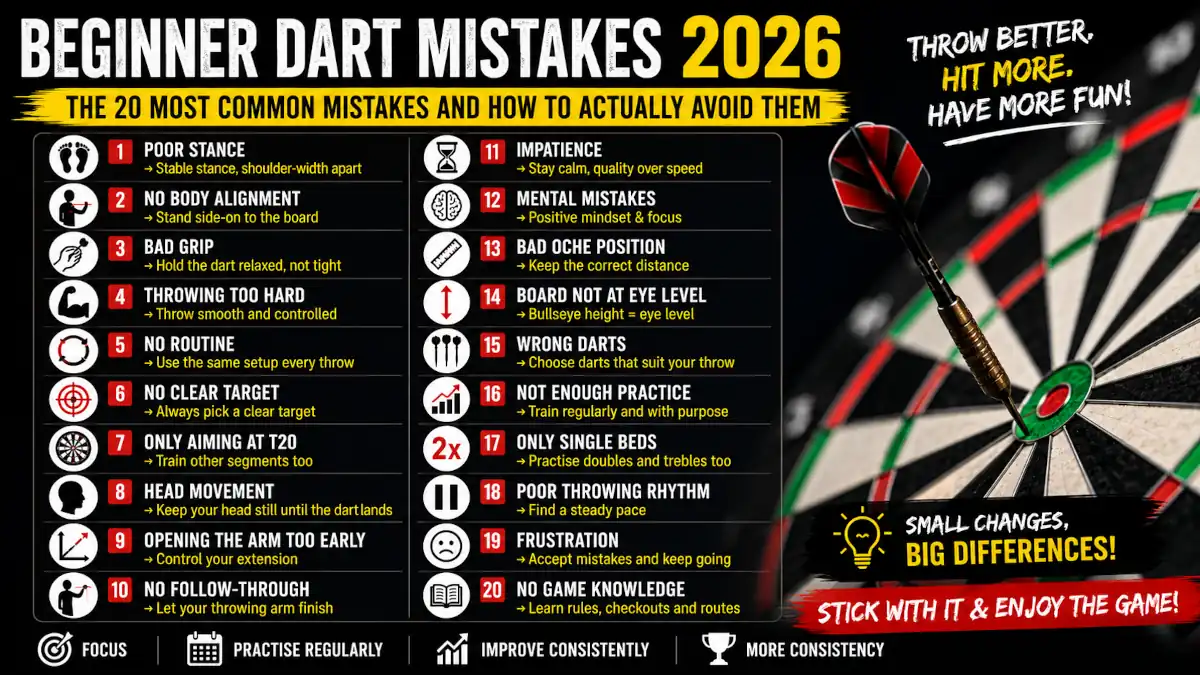
The 20 Most Common Dart Mistakes Beginners Make
- Throwing every dart as hard as possible.
- Pulling the shoulder forwards on each throw.
- Standing differently from one visit to the next.
- Rushing the second and third darts.
- Changing darts, flights or shafts every few sessions.
- Choosing a dart weight because a professional uses it.
- Playing with split or badly bent flights.
- Throwing at a board covered in shadows.
- Leaving the wall bare while plenty of darts still miss.
- Practising only the treble 20.
- Starting practice without a target or game.
- Playing rarely, then throwing for several hours.
- Changing several parts of the throw at once.
- Squeezing the barrel until the hand tightens.
- Trying to control the exact release point consciously.
- Flicking the dart from the fingers.
- Guessing the board height and oche distance.
- Using a different routine before every visit.
- Expecting tight groups after a handful of evenings.
- Blaming the equipment before watching the throw.
Why Beginner Dart Mistakes Are Normal
You are learning several things at once: where to stand, how firmly to hold the barrel, how far to draw the dart back and when to let the arm finish. Nobody tidies all of that up in three evenings.
Do not rebuild the throw after one poor visit. Throw a few more. A single dart in the 1 may be an ordinary miss. Ten darts pulling into the 1 give you something worth checking.
Your first aim is not a pretty throw. It is a routine you can repeat often enough to judge.
Keep it boring for a while: same darts, same position and the same simple routine. That gives you something real to compare.
How to Throw Darts for Beginners: Common Technique Mistakes
More force gets the dart to the board faster. It does not put it in the right segment. Use enough pace for the dart to stick, then concentrate on repeating the movement.
Your shoulder does not need to be frozen. It should not lunge differently on each dart either. Watch whether the elbow and chest move around before the release.
Know where the front foot sits at the oche. You do not need to measure it to the millimetre, but you should not wander across the line without noticing.
A high dart is not always “too late” and a low dart is not always “too early”. Do not operate the fingers like a switch. Watch whether the barrel leaves cleanly or catches the thumb and index finger.
Hold the dart firmly enough that it does not move before the throw. Once the fingers and forearm tighten, adding more grip pressure usually gives you another problem.
Keeping rhythm is useful. Throwing the next dart before you have settled is not. Stand, look and throw again.
Beginner Dart Setup Mistakes: Weight, Lighting and Wall Protection
There is no agreed beginner weight. If you have nothing to compare, 23g or 24g is a sensible middle ground. Treat that as a starting point, not a law.
You should see the wires, numbers and segments clearly. A ceiling light or lamp from one side often leaves shadows. A dartboard light spreads the light around the board.
A surround protects the wall around a standard bristle board. That is its job. It does not improve accuracy and it will not catch every wild dart.
Measure the centre of the bull and the throwing distance. Fix a board that moves on the wall. Do not blame every bounce-out on a small board movement.
Small marks are normal. Replace a flight when it splits, folds badly or no longer sits properly in the shaft.
New flights, shafts and barrels on the same evening give you no clean answer. Swap one part and play with it before changing the next.
How to Practise Darts as a Beginner
That is enjoyable, but it does not show whether you can find the other large singles. Play around the board from 1 to 20 and count how many darts you need.
Stop when you are merely flinging the darts. Three focused rounds on one target tell you more than an hour in which you barely look at the board.
That cannot be measured tonight. “Play around the board three times” or “throw 30 darts at doubles” gives you a task you can finish and compare.
Finish it. Otherwise the only thing you practise is changing the plan whenever it becomes uncomfortable.
A simple dart practice routine for beginners: warm up for a few minutes, play around the board, throw at a few doubles and finish with a leg of 301 or 501.
Mental Mistakes Beginner Darts Players Make
A few good visits show what can happen. They are not yet your normal level. Judge several legs rather than the best three darts of the evening.
The 26 is finished when you pull the darts from the board. Treat the next visit as a new job rather than a chance to continue the argument.
Somebody will always group tighter. Check whether you hit your own target more often than you did a few weeks ago.
The flight, board and tiny draught are not responsible for every poor visit. Accept the dart and throw the next one.
How to Get Better at Darts Without Rebuilding Everything
- Find the same place at the oche. Your foot does not need military precision, but you should know where you stand.
- Let the throw finish. Do not try to rescue the arm halfway through the movement.
- Practise large singles. You need single 18 in matches long before you can hit every treble on command.
- Write down one or two figures. Darts needed for around the board or doubles hit is enough.
- Keep the same setup for a while. Change one part when the same problem keeps returning.
What you can copy from professionals: they return to the oche after a poor visit and play the next one. You do not need to copy somebody else’s throw.
Beginner Darts FAQ
What is the biggest mistake beginners make in darts?
Changing several things at once. If you alter the stance, grip and darts in the same session, you cannot tell what improved or damaged the throw.
How can a beginner get better at darts?
Keep one setup for a while, find the same place at the oche and use a simple practice routine. Work on large singles and doubles instead of throwing only at treble 20.
What weight darts should a beginner use?
There is no single correct weight. If you have nothing to compare, 23g or 24g is a useful middle ground for steel tip darts. Try different weights in a shop when you can.
What are the best darts for beginners?
A straight tungsten barrel gives you several places to hold the dart. Check that the grooves sit where your thumb and fingers naturally land. Do not buy a set only because a professional uses it.
How often should beginners practise darts?
Practise regularly enough that the setup and stance still feel familiar. Two or three manageable sessions each week are more useful than one marathon session followed by a long break.
Do beginners need a dartboard surround?
A surround is useful when darts still land just outside the board because it protects the wall. It does not make the throw more accurate.
Where can I buy beginner darts in the UK?
The orange buttons on this page open Amazon UK. The green buttons open Darts Corner collections for beginner darts, steel tip darts, lighting and surrounds.
Start With a Dart Setup You Can Actually Practise On
Measure the board and oche first. Then check the light and protect the wall. Only look at new darts when you have a reason to change the weight, barrel shape or grip.
- Lighting: You can see the wires, numbers and segments without heavy shadows.
- Oche: The distance is measured and you know where to place the front foot.
- Dart weight: Start near the middle when you have no reference, then give the set time.
- Surround: It protects the wall around the board from close misses.
Amazon selector warning: the Amberjack page can show several models and weights. Confirm steel tip, model and weight before ordering.
More DartWorldHub Guides for Beginners
Open the guide that matches the problem you are trying to fix. You do not need to replace the entire setup because one dart entered the board at a strange angle.
- Dart Setup Guide for Beginners → Board height, oche distance, lighting and the first set of darts.
- Dartboard Comparison → Sisal, wiring, board fixing and the differences between bristle boards.
- Dartboard Surround Comparison → Wall protection, size and how a surround fits around the board.
- Dart Flights Comparison → Flight shapes and materials without blaming every miss on the flight.
- Dart Shafts Comparison → Short, intermediate and medium shafts in nylon, carbon and aluminium.
- Steel Tip Dart Barrels Guide → Barrel shape, weight and grip zones around your natural grip position.
- Dartboard Lighting Comparison → Full rings, partial lights and shadows across the board.
- Steel Dart Points Comparison → Point length, surface and how the point holds in the board.
- Electronic Scoring and Autoscoring → Ways to count automatically without replacing your whole board setup.
Official Darts Bodies and Useful Sources
These are the official places to check professional events, international rankings and organised darts in the UK, Ireland and North America.
- Professional darts Professional Darts Corporation (PDC) → Players, tournaments, results, rankings, tickets and PDC news.
- World darts World Darts Federation (WDF) → International tournaments, rankings, rules and member organisations.
- England England Darts → National teams, events, membership and organised darts in England.
- Scotland Scottish Darts Association → Scottish competitions, teams, rankings, diaries and rules.
- Wales Welsh Darts Organisation → Welsh events, tournament entries and national darts information.
- Ireland Irish National Darts Organisation (INDO) → Irish events, rankings, teams, policies and organisation news.
- United States American Darts Organization (ADO) → US rankings, tournaments, national events and affiliated organisations.
- North America Championship Darts Corporation (CDC) → Schedules, standings and information for the CDC tours in North America.